

PPC marketing Facebook is a practical channel for small businesses to drive fast traffic, test offers, and capture local customers without waiting months for organic reach. If you run a café or a boutique, a modest monthly ad budget can bring measurable foot traffic or checkout conversions within days. This guide focuses on clear monthly budget formulas, realistic CPC math, and three ready-made audience setups so you can launch with confidence.
Many small business owners worry about facebook ppc cost and confusing setup screens. You’ll learn a simple monthly budget formula, step-by-step campaign setup, and a weekly-to-monthly KPI routine to measure ROI. By the end you’ll have three plug-and-play audience blueprints and a quick checklist to get your first campaign running.
✓ Quick Answer
PPC marketing Facebook is the practice of running pay-per-click ads on Meta platforms (Facebook and Instagram) where advertisers pay per click to drive traffic, leads, or sales. Use clear objectives, tight audience targeting, and simple CPC budgeting to measure performance and control ad spend effectively.

Facebook PPC means you bid for attention in auctions inside Meta’s ad system and pay when people click your ad. Think of it like a local ad board where every impression and click has a small cost, and your bid, creative, and audience decide how often your ad appears. The system pairs your campaign objective with bidding options and placements across Facebook and Instagram.
Bidding, placements, and objectives interact like parts of a machine: your objective tells Meta what you want (traffic, leads, purchases), your bid strategy tells the auction how to value outcomes (lowest cost, target CPC, or target CPA), and placements determine where the ad is shown. For traffic-focused campaigns you often choose CPC bidding; for sales you may pick conversion/objective bidding to let Meta optimize toward buyers.
💡 Pro tip: If you’re unsure which objective to pick, match one objective to your primary business metric (e.g., leads → ‘Leads’ objective) and measure CPC and conversion rate for two weeks before changing strategy.
Example: run two short A/B tests — one set with CPC bidding and a ‘Traffic’ objective, and one with conversion optimization and a pixel-based purchase event. If you want visits to a new landing page, CPC keeps control over cost per click. But if your goal is purchases and you have tracking in place, conversion bidding helps Meta learn who is likely to buy.
Choose CPC when your main metric is cost per visit or you want predictable testing costs. Choose conversion/objective bidding when you have reliable conversion tracking and enough historical data for Meta to optimize toward buyers. And keep your objective aligned with the business outcome you measure on the landing page.

Facebook ppc cost depends on industry, audience competition, objective, and seasonality. A small local service will typically see different CPCs than a national ecommerce store. To budget, start with a simple monthly formula: daily budget × 30 = monthly spend. From there, estimate CPC and expected conversion rate to model outcomes.
⚠️ Warning: Avoid setting daily budgets so low they prevent learning; if your campaign can’t get at least 50–100 impressions per ad set per day, results will be noisy and optimization stalls.
Walk-through example: pick a target CPA and an estimated conversion rate to back into CPC. If you want 15 leads a month and estimate a 5% landing page conversion rate, you need 300 clicks. If you budget $600 for the month, your effective CPC target is $600 / 300 = $2.00. That CPC then informs daily pacing: $600/30 = $20 per day.
Three practical starting budgets for SMBs: a local service might start at $300–$600/month, a low-ticket ecommerce shop $600–$1,200/month, and a lead-gen small business $600–$1,500/month depending on competition. Use small tests to find actual CPC for your audience rather than relying only on averages from external sources like Moz SEO Guide or industry posts.
How impressions and CPM relate to CPC: impressions drive CPM cost, and CPC is CPM divided by CTR. Improving ad relevance and creative can raise CTR and lower CPC even if CPM stays steady. So, track CPM, CTR, and CPC together to see where waste occurs.

Follow this step-by-step checklist to launch a campaign that can deliver measurable results. Before you start, confirm billing details, business account permissions, and that the Meta Pixel or Conversions API is installed on your site.
Audience examples you can copy: Local customers — age 25–55, radius 10 miles, exclude past purchasers; Warm retargeting — past 30-day site visitors with product page views; Lookalike buyers — 1% lookalike of your highest-value customers. For CTAs, use short action phrases: “Book a Table”, “Get 10% Off”, “Shop Small Picks”.
If you also run organic efforts, link your ad copy to content on your site and use internal pages to reinforce relevance. For related support on improving site signals, check our SEO Services to make landing pages convert better from paid traffic.
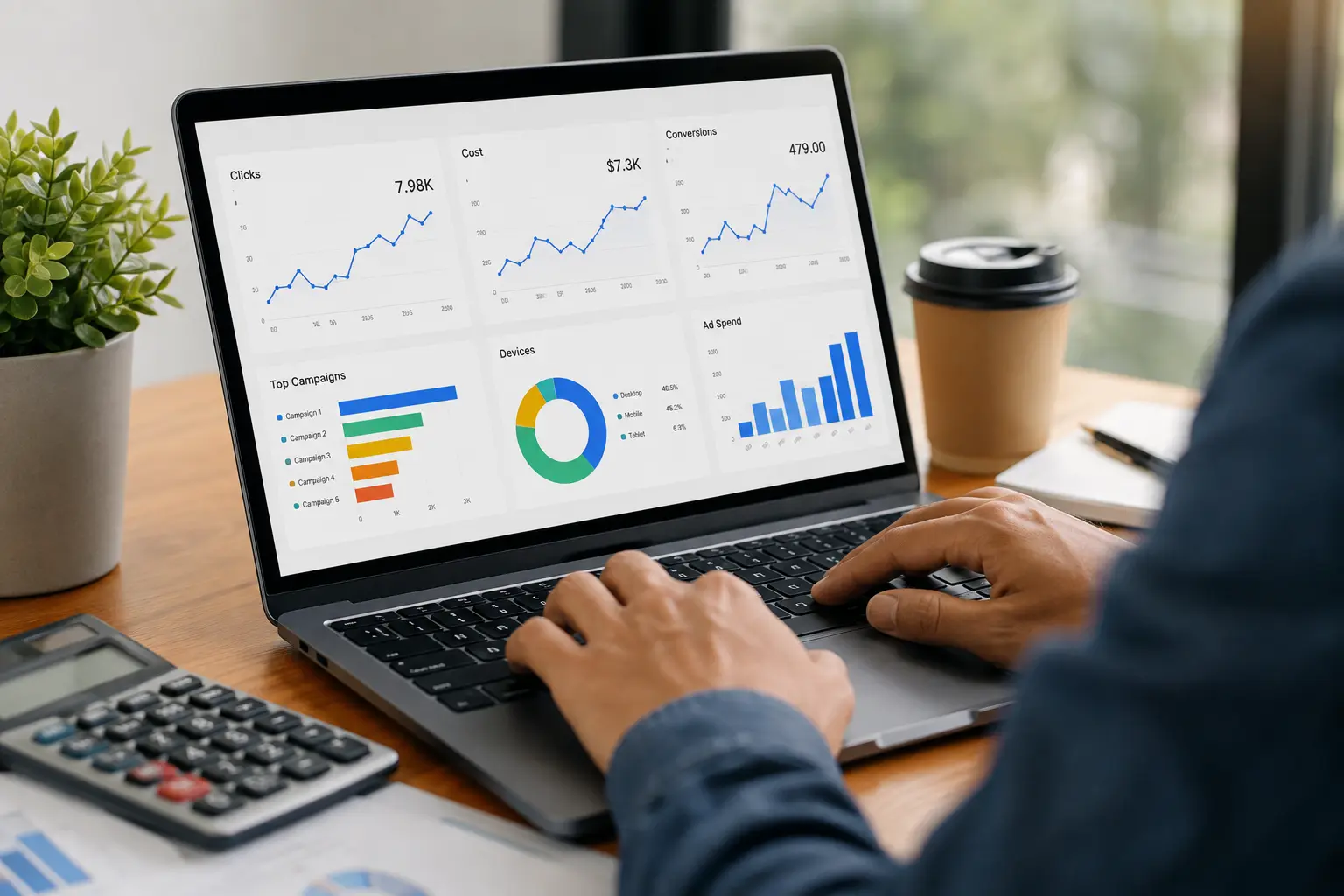
Track a small set of KPIs closely: CPC and CTR for traffic, CPA and ROAS for conversion campaigns, and CPM to understand impression costs. These metrics tell you whether the campaign is reaching the right people and converting efficiently. If tracking is limited, prioritize CPC and on-site conversion rate first.
A simple optimization cadence: check pacing daily to ensure spend matches your daily budget; swap weak creatives weekly; review audiences and conversion windows monthly. For attribution, trust short windows (1–7 days) for high-frequency purchases and longer windows for considered buys, but always compare click-to-conversion timelines before making decisions.
What signals mean you should act? If CTR is low (<0.5%) and CPM is high, refresh creative or tighten targeting. If CPC is acceptable but conversion rate is below expectations, fix landing page experience first. If ROAS drifts down after scaling, test back to smaller audiences and re-evaluate creative relevance.
To dig into impressions and auction dynamics, consider industry coverage from sources like Search Engine Land. Higher CPMs often raise CPC indirectly, so improving relevance and creative typically lowers both metrics.
📌 Key takeaway: Prioritize one KPI per campaign: for traffic use CPC/CTR, for sales use CPA/ROAS, and follow a weekly-to-monthly optimization cadence to improve results steadily.
Get a free review of your ad setup and landing pages so you can turn clicks into customers faster. We’ll give clear, practical fixes you can apply this week.
Quick answers to common questions about PPC marketing on Facebook.
PPC on Facebook is pay-per-click advertising on Meta where advertisers are charged when someone clicks an ad. It fits into Facebook Ads objectives by letting you choose traffic, leads, or conversions while controlling click costs. For small businesses, pick one objective, measure CPC and conversion rate for two weeks, and use that data to decide whether to scale or adjust targeting.
Cost for 1,000 clicks varies by CPC. Use this formula: 1,000 clicks × estimated CPC = total cost. Example CPC scenarios: low-cost audience at $0.50 CPC → $500, medium at $1.50 CPC → $1,500, higher-competition audience at $3.00 CPC → $3,000. Start with a small test budget to measure your actual CPC before planning large campaigns.
There is no one-size-fits-all answer: PPC and SEO serve different goals. PPC is better for immediate traffic and time-limited promotions, while SEO builds organic presence over months. For small businesses, use PPC for short-term demand and promotions, and invest in SEO to lower future paid dependence; measure incremental ROI for both channels to see what pays off faster.
Facebook does not pay advertisers for views; advertisers pay for impressions or clicks depending on bidding. CPM measures cost per 1,000 impressions and affects spend. If your question is about creator payouts, those are a different program. For performance, focus on CPM-to-CPC conversion and how creative improvements raise CTR to lower effective CPC.
Costs vary by industry, audience, and objective. A simple estimate is daily budget × 30 = monthly spend. Common small-business starters are in the $300–$1,200 per month range depending on goal. Start with a small test budget, measure CPA or ROAS, and scale campaigns that hit your target metrics.
Impressions determine CPM-based spend and influence CPC through auction competition. Higher CPMs can push CPC up; improving creative relevance and tightening targeting usually raises CTR and lowers both CPM and CPC. Test different creatives and targets, and track how impression volume maps to CPC in your account before scaling campaigns.