How to Convert Website Traffic Into Leads and Sales: 7 CRO Strategies for 2026
Driving thousands of visitors to your website means nothing if they leave without calling, booking a quote, or buying. When you master Conversion Rate Optimization (CRO), you can double your monthly leads and sales from the exact same traffic volume—turning your website into a high-efficiency revenue engine before spending another dollar on ads.
The 4 Pillars of High-Converting Website Traffic
To convert website traffic into leads and sales consistently, your pages must align four critical Conversion Rate Optimization (CRO) elements:
- Search Intent Alignment: Match bottom-of-funnel commercial queries (e.g., “emergency plumber Ottawa” or “Shopify SEO agency”) with dedicated service landing pages rather than generic blog posts or a cluttered homepage.
- Above-the-Fold Value Proposition & CTA: State clearly in the first 5 seconds what you do, where you operate, why buyers trust you, and give visitors a friction-free Call to Action (CTA)—including a click-to-call button and a 3-to-4 field quote form.
- Immediate Social Proof (E-E-A-T): Display verified Google reviews, star ratings, real client case study numbers, and transparent pricing ranges directly alongside your forms.
- Sub-2.5-Second Mobile Speed: Pass Google’s Core Web Vitals so smartphone visitors never abandon a slow-loading checkout or contact form.
2026 Website Conversion Rate Benchmarks by Traffic Channel
Different traffic sources carry vastly different buying readiness. Here is how average website conversion rates compare across channels—and what top-performing sites achieve after CRO optimization:
| Traffic Source / Channel | Average Conversion Rate | Top-25% (CRO Optimized) | Primary Conversion Lever |
|---|---|---|---|
| AI Search Referrals (ChatGPT, Perplexity, Gemini) | 4.5% – 7.5% | 9.0% – 14.0%+ | Transparent pricing tables, verified reviews, & direct booking |
| Google Map Pack & Google Business Profile | 4.0% – 6.5% | 8.5% – 12.5%+ | Sticky mobile click-to-call button & localized suburb proof |
| High-Intent Organic Search (Service Pages) | 2.5% – 4.2% | 5.5% – 9.0%+ | Above-the-fold quote form, case studies, & risk-free audit CTA |
| Google Ads Search (PPC) | 3.2% – 5.0% | 7.0% – 11.0%+ | Dedicated landing page matching exact ad headline & offer |
| Informational Blog Posts (Top-of-Funnel) | 0.4% – 1.2% | 2.0% – 3.8%+ | In-content CTA banners, internal links to service pages, & free audits |
7 Proven Strategies to Convert Website Traffic Into Sales
1. Attract the Right Search Intent Before Trying to Sell
The #1 reason websites suffer from sub-1% conversion rates is a mismatch between the visitor’s search query and the page’s offer. Someone searching “DIY leaky faucet fix” wants a tutorial, whereas someone searching “emergency plumber Nepean” wants a licensed technician at their door within two hours.
Action Step: Separate your informational blog guides from your transactional service pages. Use educational blog content to solve problems first and build authority, then guide readers naturally toward your commercial pages using strategic on-page SEO and internal links. (Still struggling to attract visitors in the first place? Read our guide on the top reasons why your website isn’t ranking.)
2. Pass the “5-Second Hero Test” Above the Fold
When a prospective buyer lands on your page, they decide within 5 seconds whether to stay or hit the Back button. If your top section shows a vague slogan like “Excellence in Innovation Since 2012” over a generic stock photo, you lose the sale immediately.
Action Step: Structure every hero section in our conversion-focused web design format: a specific H1 naming the exact service and location, a 2-sentence outcome statement, a high-contrast primary CTA button, and a clickable phone number.
3. Cut Form Friction (3 to 4 Fields Maximum)
Every unnecessary field you add to a quote or contact form drops completion rates by 8% to 15%. Asking a mobile visitor for their street address, postal code, budget bracket, company size, and a 500-word project essay before you have even spoken to them kills conversions.
Action Step: Keep initial lead capture forms to Name, Phone/Email, Service Needed, and a brief note—and replace generic “Submit” button text with value-driven copy like “Get My Free Quote” or “Request My Free Audit.”
4. Place Verified Social Proof Next to Every Call to Action
Buyers hesitate at the exact moment they are about to fill out a form or click “Buy.” Burying your customer testimonials on a separate `/testimonials/` page that nobody visits leaves buyers unconvinced when it matters most.
Action Step: Embed live verified Google Reviews, before-and-after metrics, and brand trust signals directly above or beside your quote forms.
5. Answer Pricing & Process Objections Upfront
In 2026, buyers researching through Google and AI assistants expect pricing transparency. Websites that hide all cost context behind “Call for a quote” lose leads to competitors who publish clear starting tiers or cost-factor tables.
Action Step: Include a realistic pricing guide or package comparison table on your service pages, followed by a 3-step “What Happens After You Contact Us” section so prospects know exactly what to expect.
6. Eliminate Mobile Load Delay and Intrusive Popups
According to Think with Google mobile benchmarks, as page load time slows from 1 second to 3 seconds, the probability of a mobile visitor bouncing increases by 32%. Cluttered sidebars, auto-playing videos, and full-screen popups destroy conversion flow.
Action Step: Use website speed optimization to keep Largest Contentful Paint (LCP) under 2.5 seconds and replace intrusive popups with clean, inline lead boxes.
7. Track Key Events in GA4 and Retarget Unconverted Visitors
Even on a top-performing website, 90% of first-time visitors are comparing 2 to 3 options before making a final decision. Configure Google Analytics 4 (GA4) conversion events (form submissions, phone clicks, booked calls) and pair your organic traffic with targeted Google Ads remarketing so your brand stays top-of-mind until they are ready to buy.
What Happens When Qualified Traffic Meets High-Converting Pages
At Profit Parrot Marketing, we never stop at rankings—we engineer every service page and e-commerce funnel to turn clicks into closed revenue:
Documented in our SEO and Google Ads case study by aligning high-intent traffic with conversion-optimized landing pages.
Generated by streamlining product category pages, Core Web Vitals speed, and checkout trust signals.
Achieved by replacing generic brochure pages with intent-matched local landing pages and above-the-fold forms.
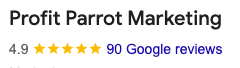
Backed by 90+ Verified 5-Star Google Reviews
See why businesses across Ottawa and Canada partner with Profit Parrot Marketing to grow both traffic and closed sales:


Frequently Asked Questions: Converting Website Traffic Into Sales
Why is my website getting traffic but no sales or leads?
When a website gets traffic without conversions, it is almost always caused by one of four issues: (1) you are ranking for informational keywords rather than buyer-intent keywords, (2) your call-to-action or quote form is buried below the fold, (3) your page lacks trust signals like verified Google reviews and transparent pricing context, or (4) slow mobile load times are causing visitors to bounce before the page finishes rendering.
What is a good website conversion rate in 2026?
Across all industries, the average website conversion rate sits between 2.3% and 3.5%. However, well-optimized local service landing pages and AI search referrals (from ChatGPT, Perplexity, and Google AI Overviews) regularly achieve conversion rates between 6% and 12%+ when paired with clear above-the-fold forms, click-to-call buttons, and verified 5-star reviews.
How do I convert informational blog readers into paying customers?
Blog readers are typically in research mode rather than ready to buy on the spot. Convert them by answering their question thoroughly with tables and checklists, embedding a relevant mid-article CTA box (such as a Free Site Audit or Cost Calculator), and adding contextual internal links pointing directly to your core commercial service pages.
How does page speed affect website conversion rates?
Page speed directly impacts revenue. Pages that load within 2.0 seconds convert at more than double the rate of pages that take 5+ seconds to load. Passing Google’s Core Web Vitals (LCP under 2.5s and INP under 200ms) keeps mobile shoppers engaged all the way through checkout or form submission.
Does AI search traffic (ChatGPT and Perplexity) convert higher than traditional search?
Yes. Because users ask detailed, multi-step comparison questions inside AI assistants before clicking a cited source, visitors arriving from ChatGPT, Perplexity, and Google AI Overviews are already pre-qualified and convert at 2x to 3x the rate of standard informational search traffic.
Should I fix my conversion rate before scaling SEO or Google Ads?
Always fix glaring conversion bottlenecks first or in parallel with traffic growth. Raising your website conversion rate from 1.5% to 3.0% instantly doubles your leads and cuts your Customer Acquisition Cost (CAC) in half without spending an extra dollar on ad clicks.
Ready to Turn More of Your Website Visitors Into Paying Clients?
Request a free SEO, AEO, and Conversion Audit from our team. We will show you where visitors are dropping off and how to capture more leads from your existing traffic.
Written by Lark Begin & Reviewed by Jean-Marc Begin
Lark Begin is Co-Founder and Head of SEO and AEO Strategy at Profit Parrot Marketing, with over 17 years of experience architecting high-converting search funnels, technical SEO, and AI search visibility behind the scenes. Co-Founder Jean-Marc Begin leads customer relations and growth consultations, while day-to-day campaign execution is carried out by Profit Parrot’s specialized in-house team.