On-Site SEO vs. Off-Site SEO: What Really Moves Your Rankings in 2026
Search engines and AI answer engines evaluate hundreds of ranking signals, but two core pillars determine whether you dominate Page 1 or stay buried on Page 3: On-Site SEO (everything you control on your website) and Off-Site SEO (how the rest of the web vouches for your authority). Understanding how to balance both is the fastest way to unlock predictable organic traffic and leads.
What Is the Difference Between On-Site SEO and Off-Site SEO?
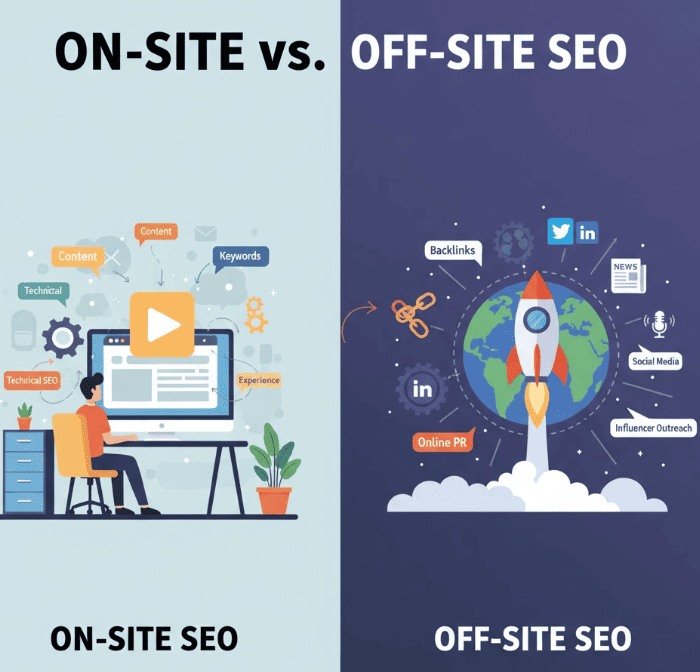
On-Site SEO (or On-Page SEO) tells search engines what your website is about, while Off-Site SEO (or Off-Page SEO) proves to search engines how trustworthy and authoritative your business is:
- On-Site SEO (100% Under Your Control): Optimizing your page content, search intent alignment, HTML title tags, H1–H3 headings, internal linking, Core Web Vitals page speed, and JSON-LD (JavaScript Object Notation for Linked Data) schema markup directly on your domain.
- Off-Site SEO (External Reputation Signals): Earning high-authority editorial backlinks, building consistent Name, Address, and Phone Number (NAP) local citations, collecting verified Google reviews, and generating unlinked brand mentions across news sites, directories, and industry publications.
Side-by-Side Comparison: On-Site SEO vs. Off-Site SEO
Here is how on-site and off-site optimization differ across control, core ranking factors, AI search impact, and timelines:
| Comparison Factor | On-Site SEO (On-Page & Technical) | Off-Site SEO (Off-Page Authority) |
|---|---|---|
| Primary Role | Establishes topic relevance, crawlability, and user conversion experience | Builds external credibility, Domain Authority (DA), and E-E-A-T trust |
| Level of Control | 100% Direct Control (you can edit code and copy anytime) | Earned & Influenced (via outreach, PR, citations, and customer reviews) |
| Core Elements | Service pages, title tags, H1–H3 structure, internal links, schema markup, & page speed | Editorial backlinks, Google Business Profile (GBP) reviews, local NAP directories, & PR |
| AI Search (AEO) Impact | Provides structured answers, tables, and FAQs that ChatGPT and AI Overviews extract | Places your brand on third-party lists, directories, and media sites cited by LLMs |
| Time to See Impact | 2 – 6 Weeks after indexing | 2 – 6+ Months of steady authority building |

Watch: How On-Site and Off-Site SEO Work Together
Short on time? Watch our quick breakdown of why neither on-site optimization nor backlinks can win competitive keywords alone:
What On-Site SEO Actually Covers (Your Website Foundation)
On-site SEO encompasses every content, structural, and technical signal you control directly on your website. According to Google’s Helpful Content Guidelines, strong on-page optimization ensures search crawlers can index your pages effortlessly while human visitors find clear, authoritative answers.
1. Search Intent & Content Depth
Mapping each service page and blog post to a specific buyer intent, backed by upfront direct answers, comparison tables, and real pricing or case study proof.
2. HTML Headings & Meta Tags
Crafting compelling meta titles (<60 characters), meta descriptions (<160 characters), and logical H1, H2, and H3 hierarchies that clarify topic structure.
3. Strategic Internal Linking
Connecting educational blog articles to high-converting commercial service pages using descriptive anchor text—see our internal linking strategy guide.
4. Core Web Vitals & Speed
Optimizing server response times, mobile responsiveness, and image compression through website speed optimization so visitors never bounce from slow pages.
5. JSON-LD Schema Markup
Adding structured data (`LocalBusiness`, `Service`, `Article`, and `FAQPage`) so Google and AI engines understand your entities, locations, and credentials.
6. Conversion Architecture (CRO)
Placing clear calls-to-action, trust badges, and quote forms above the fold so organic traffic converts into phone calls and booked appointments.
Want a deeper dive into on-page execution? Explore our complete guide to On-Page SEO Services in Ottawa.
What Off-Site SEO Is Designed to Do (Building External Trust)
Anyone can claim on their own website that they are the “#1 company in Ottawa.” Off-site SEO is how search engines verify whether the rest of the internet agrees. When reputable websites, industry associations, local directories, and verified customers reference your business, your Experience, Expertise, Authoritativeness, and Trustworthiness (E-E-A-T) surges.
1. High-Authority, Niche-Relevant Backlinks
Not all backlinks are equal. One editorial link from a trusted Canadian publication, trade association, or Chamber of Commerce outweighs 500 cheap directory links. In fact, buying bulk low-quality links can trigger algorithmic penalties. Learn how we earn safe, high-impact links in our White-Hat Link Building Guide for Canadian Businesses and our breakdown of the types of backlinks you need for the best SEO results.
2. Google Business Profile (GBP) & Verified Customer Reviews
For local businesses, your Google Business Profile and steady 5-star review velocity are powerful off-site ranking drivers. Reviews that naturally mention your services and city boost both your Google Map Pack rankings and your organic click-through rate.
3. Local NAP Citations & Third-Party AI Mentions
Consistent Name, Address, and Phone Number (NAP) listings across Apple Business Connect, Bing Places, BBB, YellowPages.ca, Clutch, and industry roundups confirm your entity identity—and directly feed the third-party sources that ChatGPT, Perplexity, and Google AI Overviews cite when recommending local providers.
Why You Need Both Working Together (Recommended SEO Split)
Pointing expensive backlinks at a slow, poorly structured website is like pouring high-octane fuel into a car with flat tires. Conversely, publishing great SEO content on a brand-new domain with zero backlinks will leave your pages stuck on Page 2 behind established competitors. Here is how we phase On-Site and Off-Site SEO across a campaign:
70% On-Site / 30% Off-Site
Fix technical crawl errors, speed up Core Web Vitals, optimize core commercial service pages, install JSON-LD schema, and clean up foundational NAP citations and GBP setup.
50% On-Site / 50% Off-Site
Publish targeted AEO topic cluster articles and suburb landing pages while scaling monthly white-hat backlink outreach and review generation.
35% On-Site / 65% Off-Site
Refresh existing content to defend #1–#3 rankings while focusing heavily on digital PR, high-authority backlinks, and AI citation expansion.
Real Results From Combining On-Site and Off-Site SEO
When our Local SEO and National SEO team pairs technical on-site restructuring with white-hat authority building, rankings convert directly into revenue:
Documented in our SEO and PPC case study after revamping on-page service architecture and backlink authority.
Generated by fixing technical indexation bottlenecks, optimizing product categories, and earning niche links.
Driven by combining on-site local landing pages with off-site Google Business Profile and citation authority.
Backed by 90+ Verified 5-Star Google Reviews
See why businesses across Ottawa and Canada trust Profit Parrot Marketing to manage both their on-site optimization and off-site authority:


Frequently Asked Questions: On-Site SEO vs. Off-Site SEO
What is the main difference between on-site SEO and off-site SEO?
On-site SEO (also called on-page SEO) covers optimizations made directly on your website—including content quality, keyword targeting, HTML title tags, heading hierarchy, internal links, schema markup, and page speed. Off-site SEO (off-page SEO) covers actions taken outside your website to build authority and trust, such as earning editorial backlinks, local citations, brand mentions, and Google reviews.
Which is more important: on-site SEO or off-site SEO?
Both are essential, but on-site SEO always comes first. Without fast-loading, well-structured pages that satisfy user search intent, search engines will not know what keywords to rank you for—even if you have backlinks. Once your on-site foundation is solid, off-site SEO provides the competitive authority needed to break into the top 3 results.
Can a website rank on Google without backlinks (off-site SEO)?
A website with strong on-site SEO can rank for low-competition, long-tail keywords or niche local terms with very few backlinks. However, for high-value commercial keywords (such as “Ottawa roofing contractor”, “personal injury lawyer”, or national e-commerce terms), quality backlinks and off-site citations are required to outrank established competitors.
How do on-site and off-site SEO affect AI search engines like ChatGPT and Google AI Overviews?
AI answer engines rely on both: they use your on-site structured content (direct summary blocks, comparison tables, FAQs, and JSON-LD schema) to extract factual answers, and they rely on off-site authority signals (third-party directory listings, review platforms, and editorial articles) to decide which brands are credible enough to recommend.
Where does Technical SEO fit between on-site and off-site SEO?
Technical SEO is part of your on-site foundation. It covers site-wide infrastructure such as XML sitemaps, `robots.txt` directives, canonical tags, Core Web Vitals speed, mobile usability, and HTTPS security so search engine crawlers and AI bots can access and index your on-page content without friction.
How do I know whether my website needs on-site or off-site SEO right now?
If your pages are not indexing, rank beyond Page 3, or have high bounce rates and low conversion rates, your primary bottleneck is on-site SEO. If your pages are well-written, fast, and stuck between positions #6 and #15 while competitors with weaker content outrank you, your primary bottleneck is off-site backlink and citation authority.
Find Out Whether On-Site or Off-Site SEO Is Holding You Back
Stop guessing why your rankings have plateaued. Request a free diagnostic audit from our team and get a clear roadmap covering technical fixes, on-page gaps, and competitor backlink comparison.
Written by Lark Begin & Reviewed by Jean-Marc Begin
Lark Begin is Co-Founder and Head of SEO and AEO Strategy at Profit Parrot Marketing, where she leads technical on-site optimization, white-hat authority strategy, and AI search visibility behind the scenes. Co-Founder Jean-Marc Begin leads customer relations and client strategy consultations, while day-to-day campaign execution is carried out by Profit Parrot’s specialized in-house team.