
When most business owners think about search engine optimisation, they picture keyword research, content creation, and backlink strategies. However, sustainable organic visibility relies heavily on a website’s underlying technical framework. As competition across digital markets intensifies, search engines are increasingly prioritising user experience and site performance over basic keyword targeting. For growing businesses, frontend marketing success is intrinsically linked to backend operations. Connecting your Enterprise Resource Planning software directly to your website is not just an operational upgrade, but a powerful technical SEO strategy that directly impacts site speed, crawlability, and overall search performance.
Organic search generates a significant share of website traffic for e-commerce brands, making technical search visibility a crucial acquisition channel. Yet, many businesses struggle with slow loading times caused by bloated third-party synchronisation plugins and disjointed software systems. A slow website can actively push down search visibility, frustrate potential customers, and increase bounce rates. Resolving these foundational issues is exactly why technical backend fixes are critical for long-term growth, as detailed in this guide exploring whether your business website is too slow for Google.
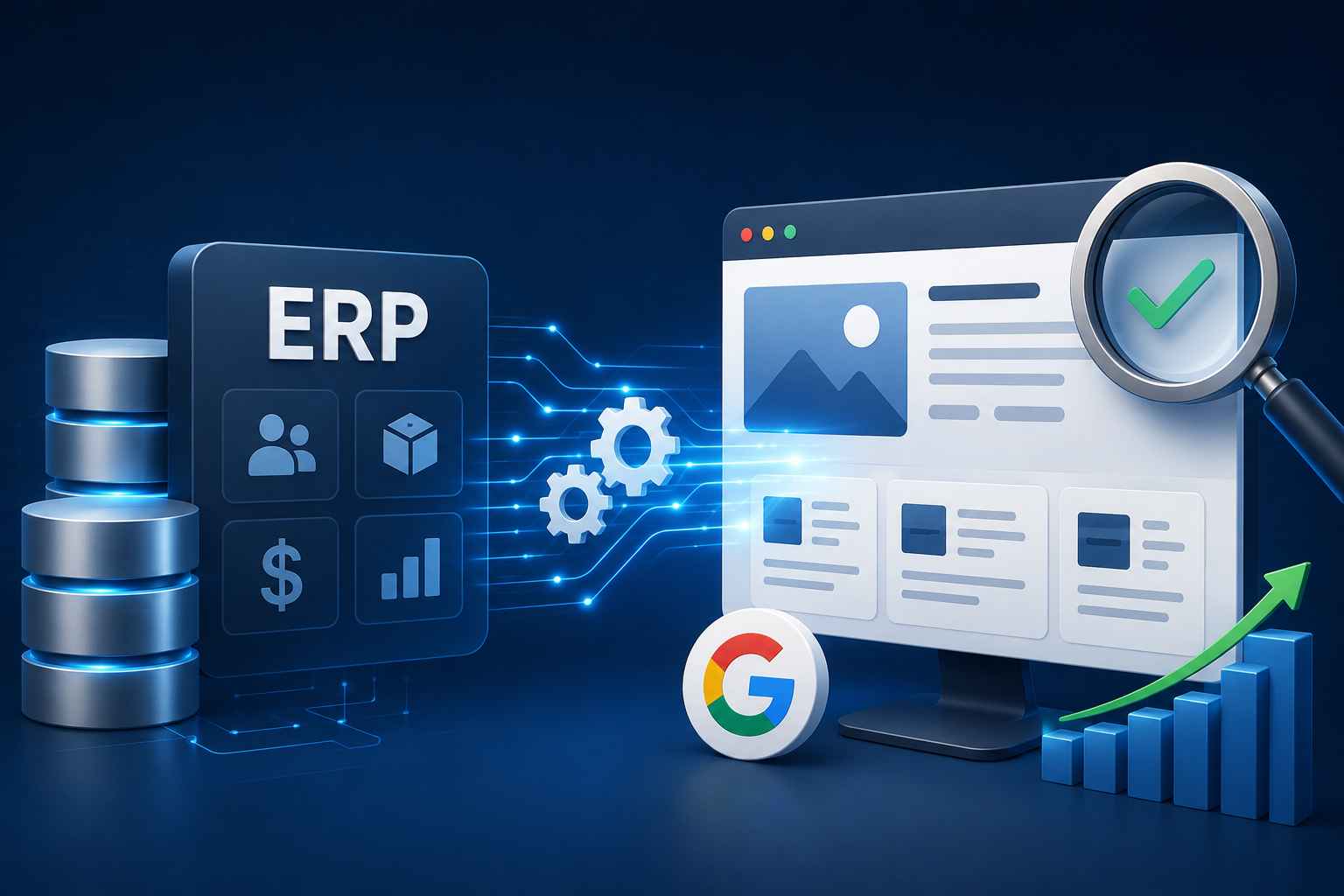
Direct integration between a robust backend ERP and a frontend website eliminates these data silos and significantly reduces server strain. By automating real-time inventory synchronisation natively, websites avoid the slow Time to First Byte often caused by messy API calls from fragmented plugins. This streamlined architecture ensures that your servers can handle sudden spikes in traffic during major sales events without crashing or lagging. Even small improvements in mobile page loading speed can have a measurable positive effect on retail conversion rates and overall user experience.
 Eradicating Data Silos for Better User Experience
Market research indicates that companies can lose substantial business opportunities due to data inefficiencies and disconnected internal software systems. When your inventory management, customer relationship data, and website operate in isolation, errors inevitably multiply. Fragmented and siloed data can also create significant barriers to successful marketing campaigns. These operational bottlenecks inevitably bleed into the customer journey, creating negative signals that search engines notice.
In regions experiencing rapid digital transformation, aligning operational data with digital storefronts is essential for maintaining a competitive edge. To navigate this technical complexity, many businesses work closely with regional technology experts. For example, collaborating with a certified odoo partner Indonesia allows growing companies to customise their open-source ERP systems for seamless web integration. This tailored approach ensures that businesses can manage multi-currency processing, handle complex localised market compliance, and deliver a frictionless digital experience for international shoppers.
When your backend architecture is properly integrated with your website, the technical SEO benefits become immediately apparent. The advantages of a unified system include:
Search algorithms heavily weigh user experience metrics, meaning that operational bottlenecks can directly impact search performance. Many mobile shoppers will abandon an e-commerce site if it suffers from poor loading times. E-commerce pages with significant loading delays can also experience substantially higher bounce rates than technically optimised, fast-loading counterparts. When users leave quickly, search engines may interpret poor engagement as a signal that the page does not adequately satisfy their needs.
Resolving these backend inefficiencies can deliver significant business benefits. Research into website performance consistently demonstrates that faster-loading e-commerce websites tend to achieve stronger conversion performance than slower alternatives. Conversion rates also tend to decline as page load times increase. This proves that speed is not merely a technical vanity metric, but an important driver of online performance and customer experience.
A modern website cannot function at peak performance if it relies on disconnected internal software. By integrating an ERP system directly with your web presence, you remove the data silos that cause slow page speeds, broken internal links, and inaccurate inventory statuses. In today’s highly competitive digital landscape, treating your operational software and your technical SEO as a single, unified strategy is the most effective way to improve user experience, reduce operational friction, and drive sustainable organic growth.